
This July, when my husband and I were in Los Angeles for a family wedding, were also able to manage a trip to Homeboy Industries. It is currently the largest gang rehabilitation and re-entry program in the world, and I have wanted to visit if for a few years now. Homeboy has come a long way from where it started decades ago in Dolores Mission, in the poorest Catholic parish in the city. A young Jesuit priest named Gregory Boyle was assigned there and served a Latino church between the two housing projects where eight different gangs vied viciously for turf. Father G, as he is called at Homeboy, recognized how dire poverty and pervasive despair fed cycles of escalating violence. So he decided to see what could be done to interrupt them. It turns out that a lot could be done — and a lot still can be.
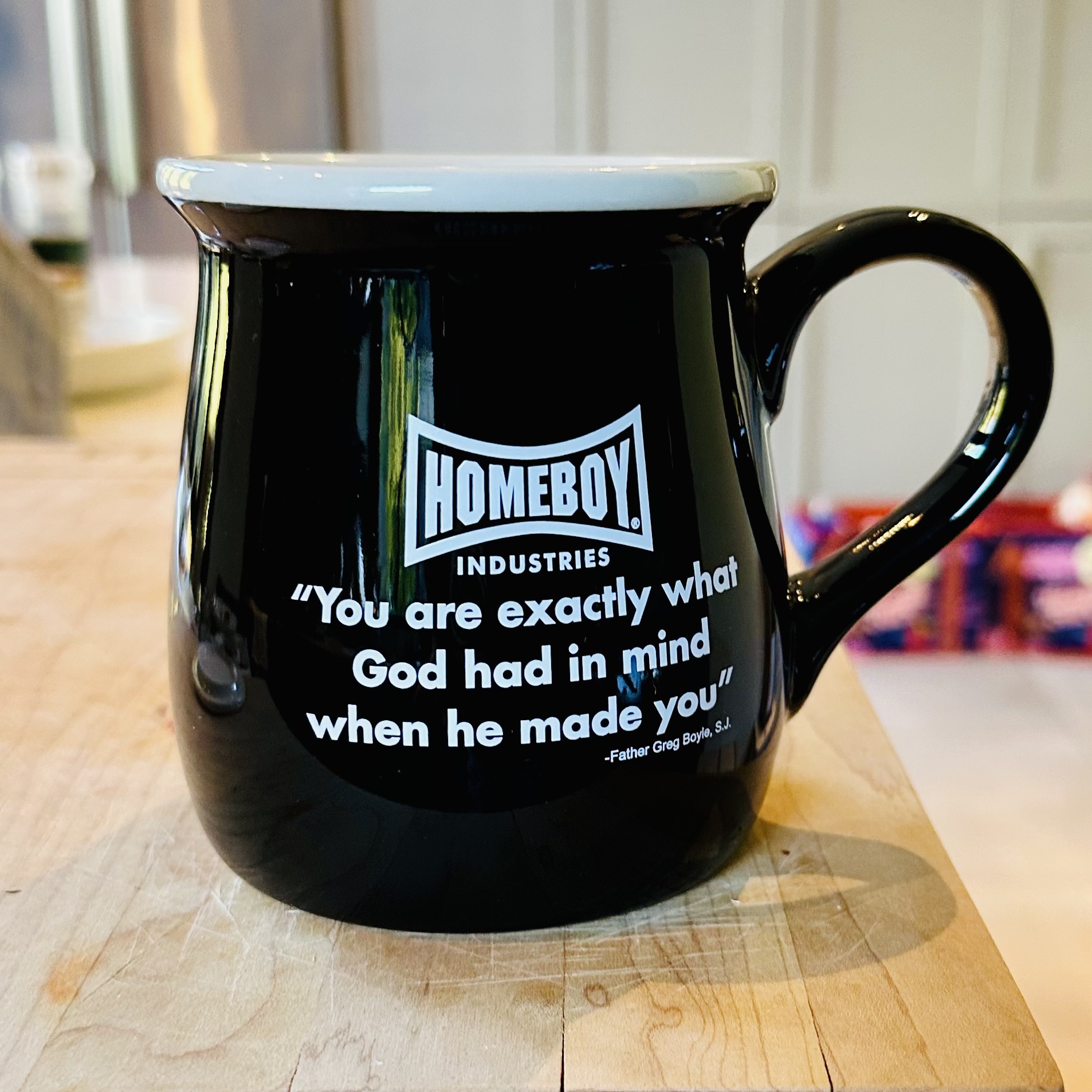
Like many people, I got to know the origin of story of Homeboy by reading Father G’s bestselling memoir titled Tattoos on the Heart: The Power of Boundless Compassion. His first book was followed by others, including Barking to the Choir: The Power of Radical Kinship; The Whole Language: The Power of Extravagant Tenderness; and most recently, Cherished Belonging: The Healing Power of Love in Divided Times. The subtitles titles are fairly self-explanatory, and they plainly point to the values that have given Homeboy such staying power over the years. These days, I think it’s fair to say, it almost as much a movement as it is an organization, which explains the existence of a growing Global Homeboy Network across five continents.
Father G’s thinking about the role Homeboy could play in L.A. has evolved through the years. Initially, it was an educational program that sought to provide the former members of gangs with the chance to continue or even complete their schooling. Then it expanded to offer employment opportunities and connect ex-convicts with what he characterized as “felony-friendly” work placements. When those appeared fairly hard to come by, Homeboy started a bakery, which was soon followed by several additional enterprises, among them a catering business and the Homegirl Cafe. Then Father G and the people he worked alongside came to realize that although education and employment made it much less likely that homeboys and homegirls would re-offend, it gave no guarantee. Father G eventually concluded that only the collective healing of individuals through trauma-informed care could provide any real preventative. The people who heal together are that much stronger for the faith they place in one another.
My husband and I arrived at Homeboy in the afternoon because the two of us had lunch reservations at Homegirl Cafe. Everyone who works in the restaurant and at the coffee counter has been involved with gangs and a number of them have tattoos testifying to that. They have tattoos on their arms and legs and hands and necks and faces that mark them in ways that no longer serve and can even jeopardize their safety. Of all the valuable services that Homeboy provides — case management, workforce development, mental health and substance abuse counseling, high school classes, financial assistance, legal aid, and re-entry support — tattoo removal is one of the most frequently requested.
This is done entirely free of charge and changes lives for the better almost immediately. At present, Homeboy removes tattoos for nearly a thousand individual per month, with 30 volunteers removing approximately 3,000 tattoos each month. No other place on the globe operates at this volume. Father G says that homies tell him while they are very used to be watched, they are not at all used to being seen. Tattoo removal allows them to begin to see themselves in a new light. So too does being beheld.
At Homeboy, people develop the habit of looking out for one another. Homies who might have watched each other warily in the past now have evident regard for one another and come to look upon their fellow homies with authentic and consistent kindness. Because Homeboy welcomes anyone looking to leave gang life behind, the former members of rival gangs encounter one another routinely. Whatever hatred they might have felt, whatever fury they might have harbored, whatever wrong was done to or by them, has to quickly become historical, if the homies are going to work together, learn together, and heal together. Not only do they bake bread together, they also come to break bread together. So they are — in the most literal sense possible — companions.
“There is no us and them,” Father G reminds everyone there. “There’s just us.” That motto is emblazoned on the merchandise that gets sold in Homeboy store, on its hooded sweatshirts and on its water bottles, but it also get reinforced by repeated encounters between those who were once the worst of enemies. That abiding belief in “just us” gets embodied and then — over time — it gets emboldened. At Homeboy, the people who once shot at each other with semi-automatic weapons now shoot one another encouraging text messages. They learn to become “courageously tender,” as Father G explains, increasingly tender with themselves and one another and increasingly determined to stay tender-hearted when any number of devastating experiences might have rather reasonably left them hardened. They discover profound inspiration in the One that Father G describes as the “God will not be outdone in extravagant tenderness”. There’s no other God I’d want ever to serve.
Once homies become willing to claim that unconditional joy Father G describes, they can pass through its portal and then hold the door open for anyone inclined to follow them. Our lunch at Homegirl Cafe that weekday afternoon was amazingly delicious. The menu showcased Latin cuisine; my husband ordered the fish tacos and the platanos fritos and I ordered the jicama salad and cucumber pineapple agua fresca. Because Ben and I had our lunch a little late, we wound up closing the restaurant down that day. As much as we enjoyed our meals, I think we were also feasting on the sights, sounds, and smells there. “Taste and see that God is good,” the psalmist exhorts us. At the Homegirl Cafe, we got the chance to do just that.
While Homeboy is explicitly not a faith-based organization, it is undeniably a spiritual community. Father G explains that a “therapeutic mysticism” hangs in the air there and we had the chance to breathe it in. One homeboy texted Father G that he had a new determination to “live in love’s energy — now I come to work and my heart smiles. I walk in the door at Homeboy and there it is — the aroma of kingship,” he declared. This aroma seems to mix especially well with the scent of churro croissants, cinnamon rolls, and coffee cakes, all of which — let me add here — are well worth tasting.
In its early days, Homeboy was met with obvious suspicion and sometimes outright hostility, from those both inside and outside of Gangland L.A., and repeatedly received bomb threats. When the original Homeboy Bakery burned to the ground in October 1999, though, The Los Angeles Times wrote that the social enterprise no longer belong to Father G but to the entire city, and it was soon sustained by widespread civic support. Last year, L.A. recorded its lowest recorded crime rate in 60 years and more that one observer has speculated that the growth of Homeboy has worked to keep it low. It has helped create a far kinder LA in its nearly 40 years of existence.
In recent years, Father G has grown insistent that all of our social ills today could be remedied by our simply remembering that we belong to one another and that no one is outside the circle of compassion, no matter what they might have done at their worst. As naive as he might sound, I do not think anyone could convincingly accuse him of naivety. He has seen too much in his time on the streets of L.A. Still, he believes we should all re-member ourselves as members of a human family bound together in inviolable kinship. “Who is my mother,” Jesus asked his followers in a famous gospel passage, “and who are my brothers?” I suspect that the homies could all readily answer that question today.
A wall outside of Homeboy Industries headquarters is painted with sunny mural by the celebrated Chicano artist Fabian Debora, a Homeboy graduate who now acts as executive director of the Homeboy Art Academy. It features two enormous angel wings unfurled against a yellow backdrop and floating underneath a halo sitting atop a graffiti tag stating simply: Kinship. The homies hanging out on the sidewalk the day we visited called out to my husband and me to stop and take our photo between the wings before we went home. Given how insistent they were, we could not possibly refuse. One of the homegirls snapped what might be my very favorite photo of the two of us, standing wrapped in wings with bright blue feathers labeled “tenderness”, “hope”, “freedom,” and “love”. Hope rises — if we let it.
“People come to Homeboy Industries with broken wings,” Fabian said in an interview about the mural he finished in 2017. “And yet in their time being [here], once they start to feel their worth and the healing starts to happen… they recapture all their feathers, in order to… expand these wings. These wings are personally… designed to embrace the homies,” he explains, and to hold their hopes throughout the decades. His mural pays tribute to the place the homies occupy in the City of Angels, which belongs to them every bit as much as they belong to it. Near the corner of Bruno and North Alameda, his mural suggests, there’s just us angels, crossing paths, lifted up by our clear intention to be tender with one another.
“Clothe yourselves with compassion, kindness, humility, gentleness and patience. Bear with each other and forgive one another,” the apostle Paul’s Letter to the Colossians directs us. “And over all these virtues put on love, which binds them all together in perfect unity.” As a minister, I take care to never use the term “religious experience” lightly. But I have no other suitable terminology to describe my trip this summer. Before I left the headquarters, I bought a copy of Father G’s latest book in the Homeboy shop. Because there were no more signed copies of it in stock, I bought one of the copies that had been sitting out on the shelves. The store clerks kept apologizing to me that I had just missed the Homeboy founder, because he starts his days early in the morning and always ends by the afternoon. Otherwise, they promised, the author would surely have signed my book. No apology was necessary, through, because nothing was missing from that day. There was no reason for me to bother the man now known as the busiest Jesuit in America. I did not need an personalized inscription when I could see his handiwork everywhere I looked.
Besides, I was glad to have the opportunity to meet the clerk and hear about how was taking classes to become a mental health counselor and how he was encouraging his friend to get more fluent in English so he too could return to school. Father G often extols what the homies have taught him and I understand better now what excellent teachers they make. He never travels to speaking engagements without a couple of homies and he never speaks without them speaking as well. They have so much to share with us.
Father G tells a poignant story about a homie whom he a met a while ago in probation camp. When he asks the young man if he has any siblings, the homie tells him that he has a brother and a sister, then quickly adds: “But they’re good.” Father G replies, “And that would make you…?” Not missing a beat, the homie says, “Locked up.” That kid from probation camp reminds me a lot of my younger brother, who got in to serious trouble with the law starting in his teen years and then stayed in trouble with the law well beyond them, who was arrested for a number of different state and federal offenses, who has for the entirety of his adult life and outside of jail felt imprisoned by his felony convictions. One of his greatest regrets before becoming permanently disabled a couple of years ago was never having his criminal record expunged or his legal file sealed. He felt as marked by his past offenses as he would have by a permanent tattoo.
What Father G preaches both at Homeboy and all around the carceral system in L.A. is that people can find a certain spiritual freedom at any point during their lives — even at the end of them. They can walk a different way with a different air, free of any previous blemish. There is not any stain on them that cannot be removed, he assure them. Their spirits are pure sterling, shining for everyone who has eyes to see. His Universalist theology finds powerful voice when he tells one homegirl, “If I get to heaven and you are not there, I’m not staying.” In the months since my return from L.A., I have been reading and re-reading his books and repeatedly listening to his speeches and presentations, which frequently make me weepy. Maybe my eyes being so shiny and wet lately means my clouded vision is at last starting to clear.
If any homies have forgotten their original goodness, Father G reminds them of it. If they have never been acquainted with it, he introduces them. He counts them among the cherished, where they belong, no matter what. When he is not busy preaching that particular gospel, he is busy promoting the Homeboy brand and selling its merchandise, usually while sporting one of its logo shirts or jackets. Because I am buying what he is selling — and I mean absolutely everything he is selling — I should tell you that do not need to make a special trip to L.A. to support Homeboy. Their famous coffee cakes are available for purchase online and can be sent anywhere nationwide. Keep that in mind; they would make ideal gifts for friends and family this coming holiday season. Those cakes are made for people just like us by people just like us, because seriously, who else is there? There’s no them, not anywhere. Just us, here. Just us.


