
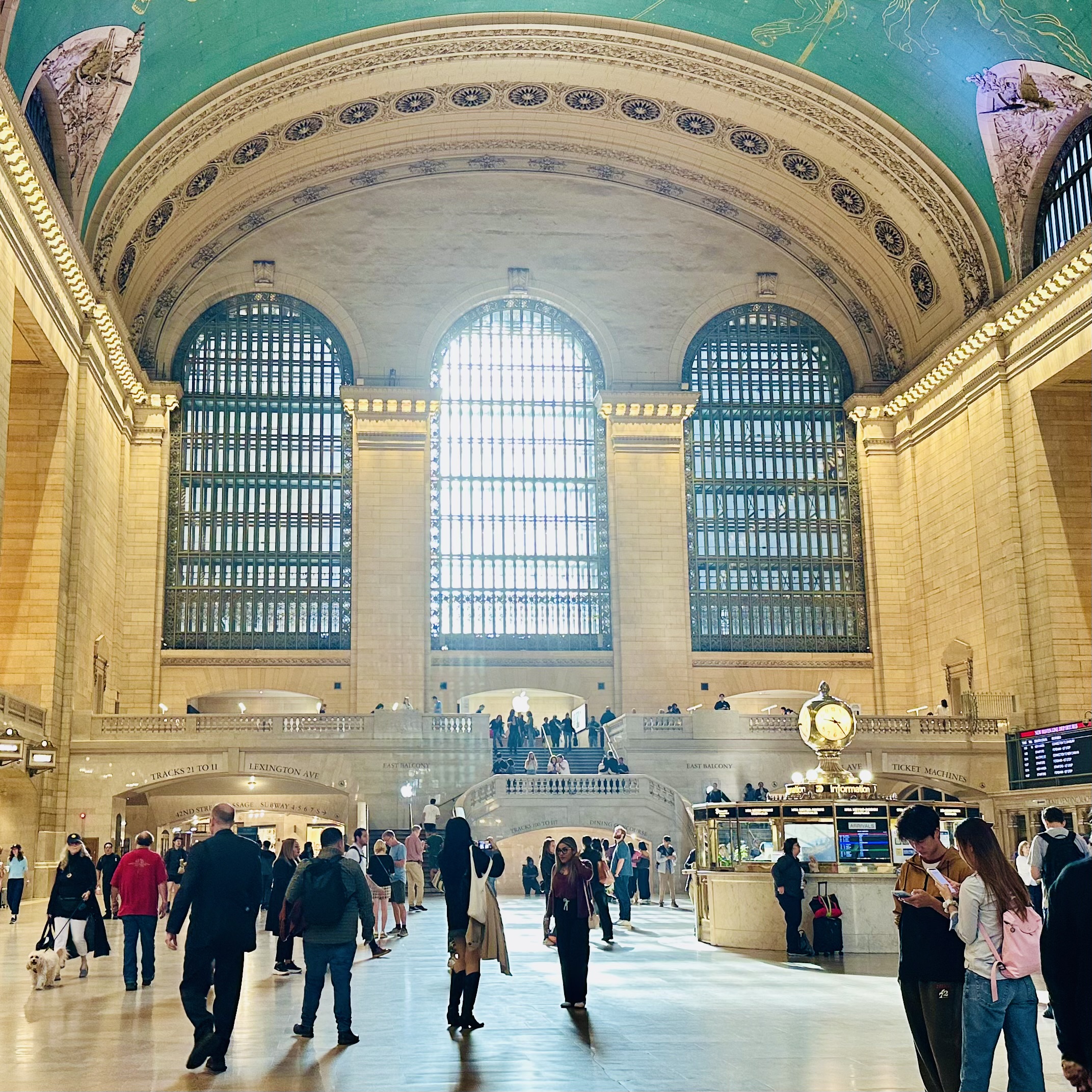
One of my very favorite things to do is say, “It’s like Grand Central Station in here” while standing in Grand Central itself. I’ve told that joke more times than I can count and texted it to friends and family and also posted it online. What could be funnier? I never get tired of telling it; as far as I am concerned, that joke never gets old. In the fall of 2025, though, when I was in Grand Central for the express purposed of visiting the fabled Dear New York exhibit, I didn’t make it once. Because during the two weeks that the massive photography show was hosted there, it didn’t resemble Grand Central as closely as usual. It more nearly resembled a cathedral to humanity, and all of the commuters and visitors became its joyful acolytes.
Perhaps you were able to see it yourself last October in the city; it was the largest scale public art exhibit in New York since The Gates wound their way through Central Park, exactly 20 years earlier. But Dear New York was set entirely indoors, underground along the tracks of the MTA subway trains and of the Metro North commuter lines, above ground in the vaunted spaces of Vanderbilt Hall and the Main Concourse. For the span of the two-week—long exhibit, there was no advertising to be found anywhere in those places, only the portraits of New Yorkers on the walls and turnstiles.
They were an amazing sight to behold, the sea of faces floating above another sea of faces, New Yorkers for as far as the eye could see. Each of these portraits was taken by photographer Brandon Stanton, who in 2010 set out to take what he called “a photographic census of the city.” In the intervening years, by all measures, he has succeeded, photographing more that 10,000 New Yorkers in all. Over the course of his amazing career, he has also helped raise tens of millions of dollars for the subjects he has photographed, putting names to their faces and telling their stories.
Even those who may not know his name may still be familiar with the platform he built, called simply Humans of New York. It has more than 17 million followers on Facebook and 12 million followers Instagram, including me and many in my circle. True to its name, it features photographs of New Yorkers — some alone in the frame, others with friends or siblings or lovers or parents or children or spouses or pets. Their portraits are always artful and often arresting, but what no doubt has helped build the Humans of New York following is the copy that accompanies each photo, snippets of the interviews that Brandon conducted while he photographed the New Yorkers he met out on the streets. He later collected their stories in to a series of best-selling Humans of New York books, the most recent of which was titled Dear New York.
In the prologue that he wrote to his latest book, Brandon described a subway ride he was taking home to Manhattan after a photo shoot he had done in Queens. Riding the 7 Train from Flushing to Hudson Yards, he had an epiphany. “Could this be the spot?” he asked himself. “The one spot in the universe, that if you were to draw infinite lines, in infinite directions, extending for eternity, you would never intersect a point with more of humanity, in a smaller place, than this train, at this moment?”
Aboard the train, Brandon recognized that among the riders, “there seems at least to be a grudging acceptance, that no matter where we came from, or where we are going, we are now on this train together.” Their lots had been thrown together in that moment; they suddenly and undeniably had a shared destination, if not a common destiny. As he observed, “on this train, God is called every type of name…. Tempers flare, voices are raised: God is love or else. Or else!” Or else what, we wonder?
No one could reasonably characterize Brandon’s work as sentimental. Rather, it is often unflinching, capturing New Yorkers from every walk of life, yes, but especially those at the margins, those who have war stories to tell, travelogues to share about what it is like to travel to hell and back again. He flatly refuses to look away from them or their plight and he will not give us permission to do so, either. He dares us to open our eyes and our hearts.
“For some on this train, it is a battle just to live. You can see it, in the black and brown faces, especially: the tired eyes,” Brandon writes at the start of Dear New York. “There isn’t enough money…. It’s never enough. But more importantly, more heartbreakingly, there is not enough time. You can see that too: people sleeping in their seats, sleeping on their feet, sleeping on their neighbor.” From my decades of living in New York City, riding various subway lines as a resident of three different boroughs, I recognize the scene he describes quite well.
There is no place on earth that I’m more likely to pray silently for strangers than the subway; even church and hospital run a distant second. There are so many battle-weary and battle-scarred passengers trying — literally and figuratively — just to get by. “Differences, nothing but differences,” Brandon muses. “In the way it is disheartening, all of this diversity. There seems to be no common thread.” Yet in his photos, he always seems to find it, the thread of our shared humanity.
Brandon catches hold of it and never lets it go. Every single one of his depictions is sympathetic, even when that might seem a serious stretch, when his subject is a drug dealer or abusive partner or absentee parent or violent criminal. Of course, there are plenty of unsung heroes and living saints he meets, as well, emergency medical technicians and public school teachers among them.
Brandon reports that his interviewing style has become increasingly streamlined over the years. These days, he usually opens with one of two questions, either “What is a significant obstacle you have overcome?” or “What are you struggling with now?” The latter is the one he prefers, however. “What are you struggling with now?” As Brandon explained to one journalist recently, ““If you can find somebody’s struggle, you can find their genius…”
American theologian the Rev. Dr. Thandeka prayed: “Be still my inner self/ let me rise to you, let me reach down into your pain/ and soothe you…” Her word help us to understand that despair is the sad result of our pain being privatized. Few things will prove as soothing as our concern for others and what they are going through in any given moment. Doesn’t their concern nearly always serve to soothe us.
What people saw on the walls in Grand Central last October, what people see when they flip through one of Brandon’s books, what they see when they stop scrolling at the latest photo posted by Human of New York and then tap a request for more, is the face of someone, anyone else who knows exactly hard it is to be human, how hard it is and also how hopeful. People are remarkably forthright and vulnerable in Humans of New York, confessing their biggest regrets and gravest disappointments and deepest sorrows for millions of strangers to read. How can we begin to comprehend the outrageous intimacy of these disclosures?
It begins, I am sure, with basic regard. Whenever Brandon takes people’s photos, they knows that they have his regard, that he is looking at them with both curiosity and compassion. He makes eye contact and then holds their gaze. He peers at them through a close-up lens. They soon understand that they are being beheld and few experiences are more heady than that. Mutual regard is also what happens in sanctuary spaces Sunday after Sunday, when people in the pews are regraded by people in the pulpit and chancel and vice-versa, when the people on one side of the table regard the people on the other side each coffee hour. So much regard everywhere. It is all a miracle to behold, when we stop to consider it.
Only, how often do we stop to consider it? “Oh, how great is the divine moral law in humanity. Vast and illimitable, it gives birth and life to all created things,” the writer proclaims in Chung Young. “It towers high up to the very heavens. How wonderful and great it is!” Indeed, it is. The icons that feature so prominently in certain religious traditions tap directly in to our most powerful devotional impulses. Whenever devout Buddhists look upon the kindly gaze of the Kwan Yin, the goddess of mercy, whenever devout Hindus look upon on the beneficent expression of the encourager god Ganesha, whenever devout Catholics look upon Mother Mary in a depiction of Madonna and Child, they get the sense that they themselves are being beheld by something divine, that they matter to a degree that they might never fully comprehend. Such immense regard…
Nearly a decade ago now, I had my portrait taken by photographer Martin Schoeller as part of a photo essay he was doing on faith leaders in the city for New York Magazine. In print, the photograph of me in my robe and stole was uniquely unflattering; nowhere else have looked so terribly Protestant and vaguely medieval. But what I remember best about that experience today was the hour-long discussion we had in his downtown studio about religion, the intense interest he brought to the topic, and how clearly I felt seen by him.
When Schoeller later published the photo, he included this quote of me: “We’re not preoccupied with who the saints are and who the sinners are because we’re all a mixture of both. The idea is to have spiritual humility… we are souls who are walking together through this world.” Honestly, I have no memory of saying that to him, but it certainly sounds like me. In retrospect, the magazine photo served primarily as the premise for our conversation.
Regard is harder and harder to come by these days, because actual human encounters are becoming rarer and rarer. We are in danger of losing sight of our shared humanity, and I am throughly convinced that those looking through a camera lens have a vast advantage over those peering at a screen. Recent articles have begun highlighting the relational harm done by phubbing, which is a term psychologists use to describe those instances where people ignore the individuals around them and give their full attention to their smartphones instead. The emotional consequences of such intimate neglect can feel devastating, especially for those raised without sufficient unconditional positive regard by their caretakers. That popular understand of intimacy as “in-to-me-see” has validity. Everyone wants to be seen, and anyone who feels invisible is suffering horribly.
Brandon himself admits the uneasy irony of popularizing his work on social media platforms, since he wants nothing so much as people encountering one another IRL, out on the streets and down in the trains. “Nobody wants to live in a metaverse, whatever the hell that is,” he stated publicly during the Dear New York exhibit. “We need to create. We need to connect. We need to serve other people if we’re going to have any sort of place or belonging in this world.” Creating, connecting, contributing: what could be more gloriously human?
That spiritual directive given in the Metta Sutta millennia ago gains special urgency today. “Even as a mother watches over her child, so with boundless mind should one cherish all living beings, radiating friendliness over the whole world,” the Buddha told followers. If we sense that there is a person or people out there watching over us, we no longer need to stay vigilant and we become more inclined to lower our guard. We may find ourselves cherished and feel ourselves loved and know we are welcomed in the world. We may start to greet its inhabitants in a much more open-hearted way.
In the prologue to Dear New York, Brandon locates the global crossroad of the subway system at the place where the 7 train intersects with the 6 train, with happens right at the Grand Central stop. “As the train pulls out of Grand Central, there is silence,” he writes. He calls this quiet “The Truce of New York.” I too know first-hand that the hush that momentarily comes over a subway car can feel sacred, as though the rails were carrying all the riders on to holy, holier, holiest ground.
There is no denying the boundless affection Brandon has for New York City and its inhabitants. Like many millions, he himself is a transplant. For years, he planned to write a love letter to the city, and Dear New York was it. Although it began as a book, it became a vision of something larger — a communal celebration, a space where New Yorkers could gather and witness, could see themselves in one another’s faces and together recognize the stark beauty of their shared humanity. “Wherever there are people, there is love…. There’s everything else here, God knows,” Brandon declares. “But alongside, among it, between it, despite it, behind it, there is love. Love too. Which means, of course, there is love on this train.” Which by extension or perhaps commutative property means that there is love, abundant love, right there at the station.
My earliest memories of Grand Central were my running full-speed through it trailing behind my father, who gave me my first desk job as a teenager at his office in Manhattan one summer and also taught me how to sprint for a train, which I can now acknowledge was a lesson I learned a little too well. Twenty years after that summer and twenty years ago this September, I was ordained in to ministry “unto the Church Universal” by the Community Church of New York, in its vast sanctuary only a few blocks south of the station, where I walked in every kind of weather. Neither my father nor my mother lived to mark that milestone with me, but their grandchildren did. Such is the march of generations.
What I always loved about Grand Central was the sea of humanity I found there, which I have in turn saw and sailed and stumbled through and at times surfed. Whenever my New York friends and acquaintances complain about their out-of-town relations dragging them down to Grand Central to take a photo in front of the iconic clock in the middle of the concourse, I contrarily insist that this is not ever an opportunity to be missed. What could make a better snapshot? Honestly: it’s like Grand Central Station in there…
Those of you well versed in your New York City trivia may already know that its official name is actually Grand Central Terminal, not station. It is a terminal because it is the end of the line for so many riders, the place they are ultimately bound, not simply a stop on the way. For this precise reason, the commuter tickets Metro North Railroad issues read GCT. When I move through Grand Central at a more human pace, as I try to these days, it seems to me a far more humane place. Humans, here, there, and everywhere, all around one another, in such marvelously close proximity. Dear New York showed me Grand Central in a different light, and for that, I remain grateful — as well as astonished. Maybe the photography exhibit merely magnified the humanity that was already there, but it was truly such a joy to behold.


Nice. Have you read Gloria Stienems new book?❤️Mom USent from my iPhoneOn Oct 7, 2026,