
In 1976, when I was just six years old, my father took our family to Newport Harbor so we could watch the tall ships sail by. Since we lived in Rhode Island at the time, we did not have to travel far. Never in my young life had I ever seen my state so crowded; throngs of people made the trip to see enormous sails fluttering in the wind. All these majestic ships were bound for New York City, where they would ultimately become part of the massive Bicentennial celebration of July 4th. The county had embraced this communal milestone, despite the political and social unrest that formed the backdrop of its observance and also that particular decade. Even though I was only a child, I remained conscious of the national mood at the time, of its somber tenor, and what I noticed along the shoreline was that rather uncharacteristically, my fellow Americans appeared jubilant. I understood that all of us together were witnessing an important and historic event, and it instantly made an impassioned junior patriot out of me.
“This is amazing,” I thought. “I cannot wait to do this again in another hundred years!”
Building upon that very peculiar and exceedingly juvenile logic, I devised a plan to live to be 106 years of age, for the express purpose of celebrating the American Tricentennial on a distant Independence Day that I expected to rival if not surpass the Bicentennial celebration. It never occurred to me that there would be Semiquincentennial celebration between 1776 and 2076, probably because my grasp of mathematics was not that sophisticated. But here we find ourselves now, in 2026, looking to celebrate the 250th anniversary of the signing of the Declaration of Independence by early framers of these United States. Today, I am highly conscious of the national mood, which I would characterize as bleak, and my curiosity about the upcoming festivities is considerable.
In the article he wrote for the forthcoming July 2026 issue of The Atlantic titled “How to Tell the American Story,” historian Yoni Applebaum observes: “It’s our 250th birthday, and no one seems to know what we’re celebrating.” That presents us with a glaring problem, one that only serves to compound the manifold other problems that Americans are facing now in the midst of our present polycrisis. “If patriotism is going to be a word that can be used in polite company, then we will need to figure out how to tell the story of ourselves,” he writes. “Because without a coherent national story, we will fail to be a coherent nation.” We will become incoherent even to ourselves.
Like our partisan politics, Appelbaum observes, our historical accounts are becoming increasingly polarized and almost impossible to reconcile. Academics on the left are inclined towards an approach that has been dubbed “post-American.” It crafts a narrative of a rapacious empire in decline approaching a well-deserved end, because it never intended to be true to its stated ideals. Its leaders were either hypocritical or cynical (does it matter much which?) and its historic record was shameful, amounting only to a lamentable litany of atrocities. Academics on the right pursue an altogether different approach, one that has been called “hyper-American,” and sound triumphalist notes and insist upon an American exceptionalism that exonerates any and all wrongs committed in the past, no matter how grievous. It frequently feels justified in omitting any troublesome mentions from the historical record, instead claiming infallible authority for flawed public figures and some problematic decisions they made.
Those of us who resist the post-American and hyper-American approaches alike are seeking a middle way, a deeper understanding of a more exhaustive and therefore mixed account of our exceedingly complicated American history, as well as a greater appreciation for its scope. Moderate centrist historians form what has been characterized as “the mainstream school,” since their thinking aligns with how the majority of Americans still understand their national legacy today. “It approaches the American story as an ongoing struggle between our best impulses and our worst,” Appelbaum explains. It does not attempt to weight the scales with too much ideological ballast, but allows the worst and the best to simply speak for themselves.
One of the better known historians situated in the center of the discourse is Harvard professor Jill Lepore. In This America: The Case for the Nation, she contends: “The truths on which the nation was founded are not mysteries, articles of faith, never to be questioned, as if the founding were an act of God, but neither are they lies, all facts fictions, as if nothing can be known, in a world without truth,” she declares. “Between reverence and worship, on the one side, and irreverence and contempt, on the other, lies an uneasy path, away from false pieties and petty triumphs over people who lived and died and committed both their acts of courage and their sins and errors long before we committed ours.” Any sanctimonious tallying of the merits and demerits of deceased Americans should be tempered by the humbling recognition that we are still racking ours up in as-yet indeterminate ratios. We need to begin by liberating ourselves from some commonplace presentist fallacies.
Those of us inclined to walk the uneasy path that Prof. Lepore describes of course harbor a hope that the thoughtful study of American history can help us become better citizens ourselves. Otherwise, it runs the risk of being an empty academic exercise or intellectual flex. Whomever we consider our ancestors, whether count them on the right or wrong side of history, we can always aspire to be the sorts of ancestors who make future generations proud.
The Rev. A. Powell Davies believed that “the American commitment” is a “purpose to be served” with “heart and conscience” and he practiced what he preached. From the pulpit of All Souls Church, Unitarian in Washington, D.C. during the 1950s, he railed against the persecution of political progressives that that Senator Joesph R. McCarthy undertook with his House Committee on Un-American Activities. An immigrant from the United Kingdom, Dr. Davies was naturalized as U.S. citizen in 1935; he appreciated that people could be made Americans as convincingly as they could be born them. It seemed to him a bitter irony that Sen. McCarthy could not recognize his own demagogic campaign as fundamentally Un-American activity. According to Dr. Davies, the foundational “American commitment is to… the rights of all people, not the special interest of some. It is a commitment to… neighborliness. It is a commitment to the common good. It protects liberty with unity… It is based upon the claim of conscience and the faith in goodness. It begins not in a system, but within the heart.”
We readily recognize what the commitment he is describing. That kind of American commitment is precisely what we saw at the start of this Semiquincentennial year, when residents of the Twin Cities squared off against the thousands of ICE agents occupying Minnesota. Those same residents were recently awarded the 2026 John F. Kennedy Profile in Courage for the “extraordinary courage and resolve” they showed in “defending the human rights and values that serve as the foundation of our Constitutional democracy.” They bravely confronted the Un-American in their midst, and to be clear — it was not the newly naturalized, the recent arrivals to the country, or even the undocumented immigrants who were un-American. It was the masked and armed occupiers.
These Minnesotans are contemporary heirs of the American Revolution; they clearly hold much the same convictions as the framers of the Declaration did. When I feel myself becoming dangerously demoralized by the current leadership of this country, I recall the bracing example of Minnesotans and think of how proud they make me to be an American. Our Declaration of Independence insists that government can only derive “just powers from the consent of the governed”, and with their widespread protest and resolute resistance, Minnesotans were steadfast and even heroic in refusing to grant their consent.
We rightly remember the 1776 Declaration for its eloquent insistence upon the self-evident “truths” that people are endowed by their “with certain unalienable rights… among these are life, liberty, and the pursuit of happiness.” As fervently as it extols those ideals, the “the unanimous declaration” of the first thirteen states in America more fervently denounces obvious abuses of power by the British monarchy, which it variously depicts as as “despotism, “tyranny”, “injuries and usurpations”, “circumstances of cruelty”, and “dangers of invasion from without and convulsions from within”. The catalogue is lengthy, because it was meant to provide a exhaustive enumeration of all we aim to get free of in this country.
We are living through such a difficult chapter in the history of our country in 2026, and this kind of civic strain takes a serious toll on all of us — mentally, emotionally, physically, and not least, spiritually. Some commentators have named our collective experience of current events as moral shame or moral anguish; either seems apt, though I myself prefer the term moral mortification. The state of the Union keeps many of us up late and wakes us up early all too often. Seeking relief and solidarity, I — like many of my co-religionists — have participated in No Kings political protests. I have stood beside other local protestors in the New York area holding signs proclaiming “No Kings Since 1776” and held a sign of my own in one hand and waved the Stars and Stripes with the other.
All this week is National Flag Week; the commemoration started on Flag Day, marked for several decades now each June 14th. This holiday celebrates the formal adoption of a flag in 1777 by a continental congress announcing that “the flag of the thirteen United States be thirteen stripes, alternate red and white; that the union be thirteen stars, white in a blue field, representing a new constellation.” While the number of stripes has stayed constant for nearly 250 years now, the number of stars has changed over the century. In America today, on the flags we fly, there is always the possibility of a new constellation taking shape. I find that fact inspiring.
What I find dispiriting is just how reluctant religious liberals and political progressive appear to fly the flag and claim it as our own. Like the land itself, this flag was made for you and me. One of my dearest mentors in ministry, the late Rev. Dr. Forrest Church, was Senior Minister at the Unitarian Church of All Souls in New York City; he was also a scholar of American history and a U.S. senator’s son. I had the opportunity to serve as one of the student ministers at his church more than 25 years ago now and was on staff there for 9/11 and it aftermath. Dr. Church repeatedly called on his ministerial colleague to not surrender the flag to neoconservatives and reactionaries but to instead honor its potent symbolism. He understood it to signify to a true American patriotism, not a pernicious ethnic nationalism.
In his book The American Creed: A Biography of the Declaration of Independence, Dr. Church writes, “What makes us all Americans — whatever our differences — is adherence to a creed, a creed based upon cornerstone truths the founders believed ‘self-evident.’ From the earliest days, the survival of the new republic hinged not merely upon the expression of these grand principles of liberty and equality but upon their spiritual underpinnings,” he concludes. “Freedom and faith were intertwined…” They may be inextricably intertwined, because unless we continue to place our faith in freedom, it will disappear.
The more vocal blood-and-soil nationalists get in America, the more loudly we need frank patriots to raise their voices. One such patriot was the U.S. senator during the Reconstructionist era who defined the motto “my country, right or wrong” to mean: “If right, to be kept right; and if wrong, to be set right.” It’s just such sentiments we hear echoed in the Katherine Lee Bates lyrics to“American the Beautiful”, which was very nearly selected as a our national anthem. Today, it remains a beloved standard as well as a sung prayer, a petition for American “to crown [its] good with brotherhood”, to have “all success be nobleness”, to make “every gain divine”, to “mend [its] every flaw,” “to confirm [its] soul in self-control, [its] liberty in law.” Let all Americans alive today say, Amen! If we would live faithfully in the land of the free, we must first be brave enough to take an honest moral accounting of ourselves.
I never full so acutely American as I do when I am abroad. For the intervening decade since 2016, that has been an admittedly uncomfortable proposition to me. In 2017, I was invited to Hong Kong to teach a weeklong intensive course in post-traumatic growth to seminary students training to become spiritual directors. Invariably, our classroom discussions circled a painful collective trauma, namely the tragic failure of the 2014 Umbrella Movement to bring about any democratic concessions from the Chinese government. If anything, those widespread protests seemed to accelerate a program of political suppression and to intensify the annihilation of dissent. The scope of my students’ shared heartbreak was staggering; their anguish of having their democratic hope dashed felt almost crushing. One evening, after the class had another poignant conversation, one of the people from the seminary turned to me and plainly and plaintively told me, “We need very badly for our American friends to succeed.”
That sentence has echoed in my mind ever since. “We need very badly for our American friends to succeed.” Sadly, the Chinese crackdown has only continued to worsen in Hong Kong during the past few years. When I think of how badly how many of the world’s inhabitants need for their American friends to succeed, I am chastened. Now more that ever, I am convinced that none of us in this country today are at actual liberty to be post-American in word, thought, or deed. Nor are we at liberty to deny the disgrace that hyper-American imperialists have visited upon our flag. We care, as Rabbi Mordechai Kaplan said in his 1951 Flag Day prayer, about what “the flag means in our life and the life of [humankind]… the institutions… the ideals, the human relationships that the flag betokens. To these our loyalty is directed.” Traveling to South Africa last month, I was sickened by a sudden realization of what the recent discontinuation of the U.S. Agency for International Development (USAID) meant for an entire continent ravaged for centuries by the global slave trade and Western colonialism. What kind of neighbor will America be in this world community of ours?
My father had tremendous love for this country and he intended to impart that to his children. Like many in his generation, he was a military veteran educated on the GI bill. He was convinced of the singular promise of the United States and thought it stood as a beacon of hope for the whole world. He was raised us with the belief that America was great because it was a nation of immigrants. Even if I can no longer subscribe to this historic account with its erasure of the Middle Passage and the dispossession of native tribes, I can appreciate the truths it holds about aspects of the American experience as it has been lived though the generations. When my father took us to see the tall ships sailing to the Bicentennial celebration, he told us that we were standing on the shores of these United States because our ancestors once boarded boats and sailed to America. Yet the same immigrants Americans used to valorize too many Americans now vilify. Today, for the first time since the Great Depression, the United States finds itself an era of negative migration, meaning more people are leaving this country than coming to it. That strikes me as a particularly disturbing development.
“But where are we going to be, and why, and who?” poet Miller Williams asked in the 1997 inaugural poem he delivered on the U.S. Capitol steps. “The disenfranchised dead want to know. We mean to be the people we meant to be, to keep on going where we meant to go.” We dare not stop here now, in a very worrisome period of democratic backsliding and the erosion of customary checks and balances. We must press forward.
In Washington, D.C., the city where I spent almost the entirety of my twenties and that I came to love deeply and stubbornly, we see our public institutions and even national landmarks being dismantled. We witness widespread failures at the federal level to honor the rule of law and the separations of powers. We watch democratic norms and standard of decency repeatedly being flouted by a president and members of his administration. We watch the interests of corporations trump the concerns of citizens. We see the blatant and unapologetic corruption of kleptocrats being tolerated, humored, normalized. Our military forces have been wantonly mobilized in acts of international aggression. We have indiscriminately imprisoned and deported countless individuals under the guise of immigration enforcement. We have seen the rights of women and racial minorities stripped away by recent Supreme Court decisions. We have squandered our national resources and surrendered precious environmental protections. With our intensifying political polarization, degraded public discourse, rancorous partisanship, and near-constant gridlock in the national legislature, we stand in desperate need of wholesale governmental reform. The next few election cycles might quickly bring us to the verge of a constitutional crisis. At a recent speaking engagement, Prof. Lepore told her audience, “I have never felt so much in a foreign country as I do in my native country today.”
However foreign it might feel to us lately, though, this plainly remains our country. I am so exasperated by the foolish back-and-forth of “This is not who are” and “This is exactly who we are” rhetoric. Few exchanges could be more pointless. Whatever we might be or not be, we Americans are undeniably a we, as in “we the people”, and we now have so many sins to atone for, so many errors to correct. We could quickly compile a list of grievances about our present political leaders at least as long as those filling page after page of the 1776 Declaration of Independence. Suffice to say, these are perilous times. I will not deny that odds today are stacked against democracy. Truthfully, the odds were always stacked against democracy. We have a tendency to forget how revolutionary the American Revolution was. So we have plenty of good reason to celebrate July 4th, this year and every year.
In 1968, the same year that Simon and Garfunkel released their folk standard “America” confessing to feeling lost and “empty and aching” and not knowing why, the Rev. Dr. Martin Luther King he delivered his last speech in Memphis. He gave it the night before he was assassinated and it is agonizingly obvious to me, each time I listen to it, as I do every MLK Day in January, that he is entirely cognizant as he speaks that he will soon be dead. He assures his audience that he is not afraid to die, that he is “not worried about about anything,” that he is “not fearing any man”. Primarily for this reason, I consider his Memphis speech to be tantamount to his ethical will.
Dr. King describes witnessing “the humans rights revolution” brought about by those in the Civil Rights Movement “standing up for the best in the American dream and taking the whole nation back to those great wells of democracy, which were dug deep by the founding fathers in the Declaration of Independence and the Constitution.” They are the same wells that Dr. King returns to when speaks what effectively are his dying words. “All we are saying to America is, ‘Be true to what you said on paper.’” That is indeed what all of us in America need to keep saying, now more than ever. Be true to what you said on paper — because what you said on paper was true. We too hold these truths to be self-evident.
From his Washington pulpit, Dr. Davies preached that “a nation, like an individual, must have a soul.” We need to be willing to fight for its soul of America, with all our hearts and minds and strength, tirelessly and continuously. We have to lift up “the moral progress [it] has sought”, as Dr. Davies encouraged us to do, and all of its moral exemplars, living and dead. This past Flag Day, not at all coincidentally, another No Kings event was held in New York City. Songs of freedom rang out as attendees once more proved that protest in eminently patriotic. This year, Juneteenth falls on the Friday of National Flag Week, as a landmark to some of the moral progress we have made in this county. In just a few weeks, we will be celebrating July 4th during a milestone year. Only, how will we do that?
It is not the least bit surprising to me that the White House cannot manage any convincing celebration of the 250th anniversary of the Declaration of Independence. I have my doubts that any of its inhabitants have read it recently, let alone understand its import or endorse the American creed it gives such full-throated voice. So please, my fellow American, whatever you do, do not take your cues from the White House in 2026. It behooves this presidential administration for people of goodwill to despair and so we most resolutely cannot. We can convincingly celebrate our 250th and it seems imperative that we do so. It has become our solemn civic duty. As one historian tells Yoni Appelbaum in his forthcoming article in the July 2026 issue of The Atlantic, “Realizing what we’re losing might enable us to remember the America we want.” Do we recognized what a magnificent inheritance we are in danger of losing for posterity? This year provides us all with a golden opportunity to make American patriotism mainstream. Never forget that a heartbroken patriotism is an honest patriotism. It contains such important truths about how we live now.
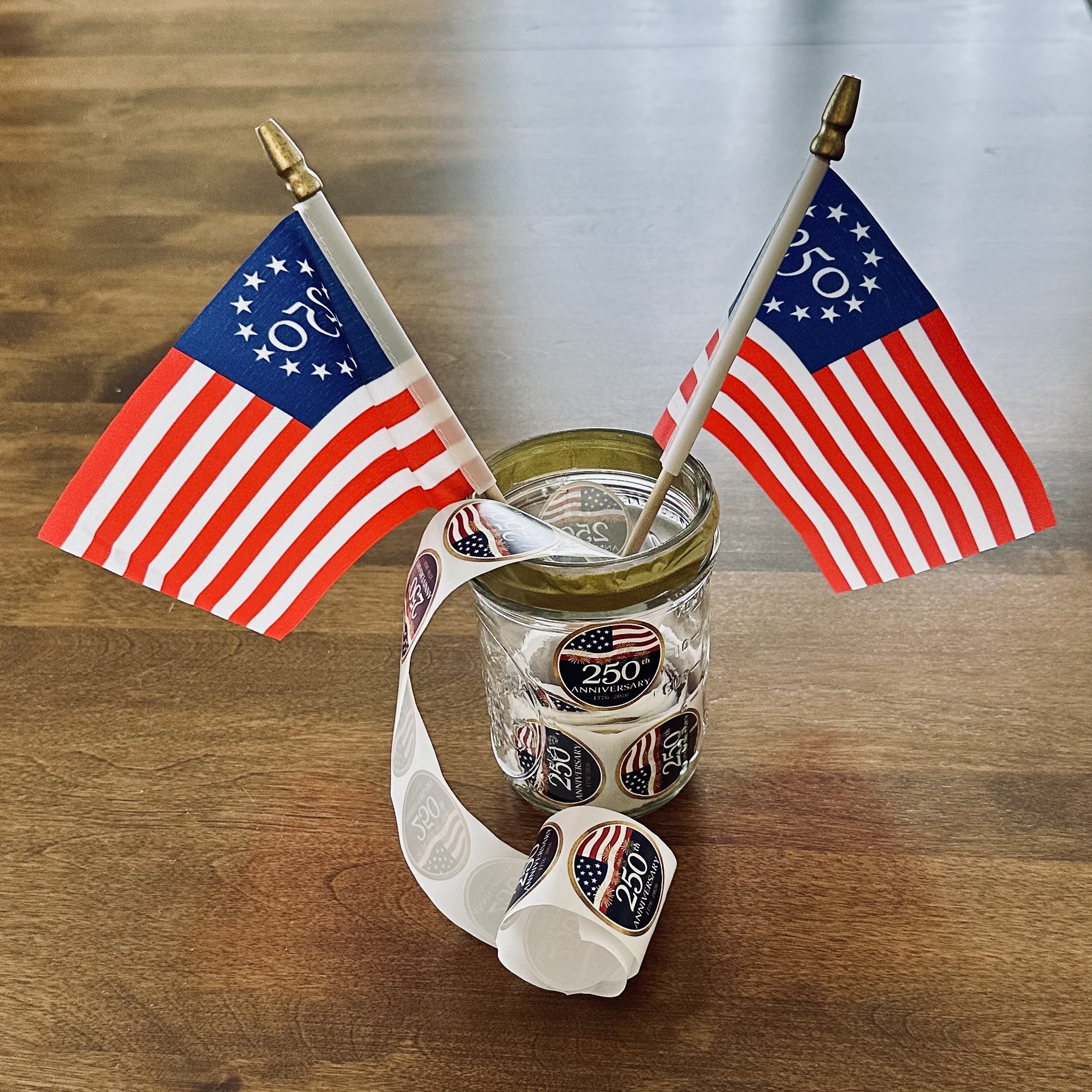
To honor the Semiquincentenial, the Smithsonian National Museum of American History on the National Mall is showcasing 250 representative items it its “In Pursuit of Life, Liberty & Happiness” exhibit. Borrowing from that, I am encouraging all American citizen to curate their own collections of 250. Perhaps it’s a list of 250 American figures you admire or perhaps it is 250 American sites you loved visiting or 250 songs you know how to sing by heart. What matters is that we compile these lists and share them with one another. Recollect your loves! Nothing is more loving than us recollecting our loves. So recollect your loves. If we cannot agree on how to tell a single American story, we may need to get in the habit of simply telling our American stories, plural, to each other. When I was preaching on Flag Day this past Sunday, I brought to church Mason jars filled with small American flags commemorating our 250th. I invited everyone there to take one as a reminder to not neglect our national milestone this summer.
By all means, begin celebrating the 250th today! Start during National Flag Week. If you cannot credibly celebrate July 4th in your national capital, celebrate instead at your local library, in your faith community, with your public schools, at your nearby civic center. Find reason to rejoice at the grassroots, where our human flourishing is most likely to take place.
On the week of July 4th, 2026, a flotilla of Tall Ships will sail in to New York Harbor as part of Sail4th 250, and once more, many decades later, I will not have to travel too far to see them. I look forward to seeing their enormous sails fluttering within sight of the Statue of Liberty, which greeted so many boatloads of immigrants (among them my own ancestors) with a blessing upon their “yearning to breathe free”. My wish is that the Semiquincentennial celebration holds some jubilant moments for those in the crowd, for the youngest American and the oldest and everyone in between.
Democracy is a very human system of government attempted by a collection of all-too-human individuals, but it stands the greatest chance of success when we allow it to strengthen our shared sense of human dignity and expand our awareness of human possibility. Democracy is indeed as much a spiritual practice as it is a political system; it is worth our upholding in good faith. Now that I am more than halfway to 106, I no longer have the same vehement determination that I once did to mark the Tricentennial. I do not care as much as I once did about my personally celebrating Independence Day fifty years from now. Yet I care immensely that that future generations of American celebrate through the years and my sincerest hope is that they are still celebrating the national holiday 250 years from now, at a proper Quincentennial. That is my hope — and I should say, since I can make a secret of it no longer — that is also my prayer.


