
Ordinarily, I am not in the business of setting world records. Last year was different, however. I was one of approximately half a million people to walk the Camino de Santiago, a network of European pilgrimage routes leading to the great cathedral in the Spanish city of Santiago de Compostela. By all accounts, this was a record number of arrivals. We pilgrims came from countries around the world and walked different directions through the surrounding countryside, all with this singular destination in mind.
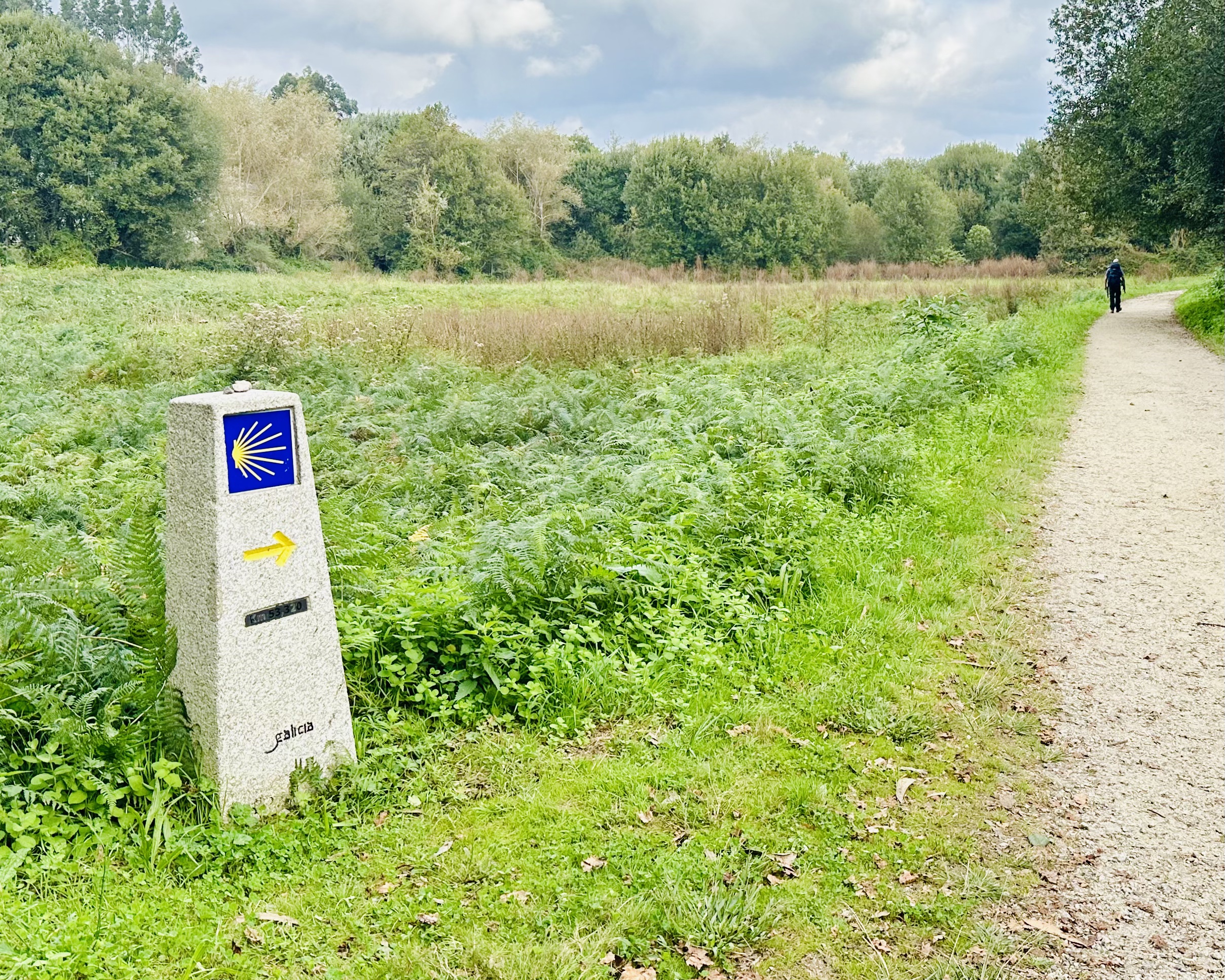
Early in the fall of 2023, my friend and I took the central Portuguese Route from Rio Minho, the river dividing Portugal from Spain; we spent a week walking from town to town, 15 miles or more each day, doing what people have done for over 1200 years now, carrying the same symbolic scallop shells on our backpacks that they wore on cords around their necks, saying the translated words of the same prayers. Like hundreds of thousands of others, we were determined to join their ranks. We wanted to be counted in their company.
Nearly all the religious traditions of the world hold out pilgrimage as a vital spiritual practice. In medieval Europe, Christians often felt called to pilgrimage as a personal expression of their deep devotion. The greatest and most ambitious pilgrimage they could make was to the Holy Land, where Jesus laid buried for three days, but few could manage those immense distances on foot or boat or horseback all the way to Jerusalem. Two places remained more reasonably within the reach of Christian pilgrims: the tomb of Saint Peter in Rome and the tomb of Saint James, or Santiago, as the Spanish call him.
During the middle ages, the cathedral at Santiago welcomed roughly a quarter million people a year. Those were tremendous numbers at a time when the population was much smaller than it is today and no options for mass transit existed. Travel was perilous then; this was a trip that no one took casually. The pilgrims who finally arrived were given a document of completion known as the Compostela, written in Latin. A copy of that is still given out today at the Pilgrim’s office, and my parchment now sits in my office, framed. It explains that I made my pilgrimage “pieta causa,” which translated means, for “the sake of piety”. As touching as I find that phrasing, I do not think provides a complete account of my motivation. If I am honest, my own motives were mixed.
Nearly 20 years before I made my journey to Santiago, a seminary professor from Canada named Arthur Paul Boers made his on the lengthier French Route. He spent a month walking from border of France with Spain, traveling five hundred miles all so he could — as he joked — “go to church”. Recognizing that pilgrimage is an enduring religious practice, he wanted to better understand the spiritual rationale for it. He also wanted to explore its widespread appeal in an increasingly secular age.
In his 2007 book, The Way Is Made by Walking: A Pilgrimage Along the Camino de Santiago, Prof. Boers notes that making a pilgrimage provides all of us with an opportunity for “focal living”, which “helps us identify and perceive … ‘something more’,” he explains, “a quality of life that we miss and long to find.” For some, that something more will be the presence of God; for others, it will be something different. Whenever we are living focally, we have a focus that organizes all our days and mobilizes our individual efforts into a communal initiative. “Focal things move, teach, inspire, and reassure,” Prof. Boers maintains. Along the Camino, of course, the focal point is Santiago. Yet ultimately, the cathedral in Santiago is not the point in and of itself.
Everything that happens along the way satisfies what Prof. Boers enumerates as the four focal criteria: first, there is no place pilgrims would rather be in that moment than there on the Camino; second, there is nothing else people would rather be doing in that moment than making a pilgrimage to Santiago; third, there is no one else people would rather be with in that moment than their fellow pilgrims; and finally, there is no way they could ever forget the momentous experience of making their pilgrimages together. Recalling his own experience on the Camino, he observes, “People were correct that something spiritually unique was afoot. I sensed it too…”
In his survey of biblical literature, Prof. Boer concludes that it is rife with mention of waymaking, wayfinding, and waykeeping, in the Hebrew Scriptures and Christian Testament alike. “Faithful people are repeatedly and providentially called to go elsewhere, be displaced, and meet — even be — strangers,” he explains. While the title of his book, The Way Is Made by Walking, is a line borrowed from a twentieth-century Spanish poet, Boer contends that the sentiment it voices is actually an ancient one. “Walking is an essential human faculty,” Boer declares. “It is deeply connected to who and how we are, and to who and how God made us…..”
Before I left from Spain last September, I spent months doing training walks. My friend and I shared our ambitious schedules with one another and cheered each other on as we went for five- and six-hour long walks on weekend days. Neither of us was taking this pilgrimage lightly; the existential stakes felt too important. We had each left our churches within months of each other. I was departing congregational ministry altogether, while she was concluding a nearly 20-year career as a religious educator. We shared keen disappointments; we had wearied of the heightened conflicts and controversies at the local and national levels and had little confidence in the ability of denominational leadership to manage worsening divisions within the ranks.
My friend was the one who originally insisted that we find some way to commemorate our landmark passages and I was the one who suggested that we walk the Camino de Santiago. We had almost no idea what we were doing, let alone which route we would take. I think we both of us were trying to answer a question about whether we could somehow keep the faith even as we were felt ourselves in decided danger of losing our religion. The heaviness of that weighed upon us more than anything we carried in our backpacks.
It turns out we could keep the faith — and did, as we helped each other along the Camino Portugues. Inside the pilgrim’s credential I brought with me from the United States was a prayer that the American Pilgrims on the Camino had adapted from the Codex Calixtinus, a 12th-century manuscript written in Latin that provided guidance to pilgrims walking to Santiago. Along the way, I amended it, so that my friend and I were included in its petitions alongside our fellow pilgrims. I said it in the first church we found each morning we set out together:
God… Guard all your children who, for love of your name, make a pilgrimage to Compostela. Be our companion along the path, our guide at the crossroads, our strength in weariness, our defense in dangers, our shelter on the path, our shade in the heat, our light in the darkness, our comfort in discouragement, and the firmness of our intentions, that through Your divine guidance, we might arrive safely at the end of our journeys and, enriched with grace and virtue, may return home filled with salutary and lasting joy.
The words reminded me to pay attention to the abundant goodwill that pilgrims almost unfailingly directed toward each other, the benevolence that felt palpable upon those dusty paths where the feet of the devoted had trod for centuries. When pilgrims passed each other, they usually wished one another, “Buen Camino!” The literal translation from the Spanish is “Good Way”, but the figurative one is this fuller throated and whole-hearted wish: “Blessings on the journey!”
We needed all the well wishes we could get on the Camino Portugues. We were walking in the middle of a surprise heat wave and suffered for it. The pilgrims who had started farther south on the route, in Lisbon or Porto, arrived in the towns we were headed wearing ankle wraps and knee braces, all manners of slings and supports. Everyone was always complaining of blisters. Mine worsened with the days and were tended to by a Canadian nurse, an Argentinian anesthesiologist, and a Spanish pharmacist, each in turn. I suspect that the kindly psychotherapist from Seattle may have given me the very last of his bandages. All of that was afoot on the Camino, too.
Eventually, I hung medical tape off the a loop in my backpack so that other pilgrims would know that I had some and was happy to share it with anyone who needed it in order to press onward. We would see each other through to the end; of that we had no doubt. Mile after mile, we discovered ourselves stepping in to our strength. Our shared sense of mission brought our best selves forward and increased our generosity with one another — and with ourselves.
If the Camino is a processional, it is one that has spanned centuries and carried millions of people to Santiago and seemingly has no end in sight. The ministerial colleague who preached the sermon at my 2006 ordination service had recently returned from Santiago a few weeks earlier and the gift she gave me that day was a souvenir shell strung on a bright red cord. Centuries ago, such a shell would have been instrumental as well as ornamental; it could have served as a scoop or ladle or spoon. On occasion, I wore it over my robe and stole to officiate at a special service. In retrospect, though, I see that I carried it with me from church to church, hanging it in office closets and robing rooms as a chit I planned to make good on some day. Last fall, at long last, I did, with the help of my friend and some fellow pilgrims.
A favorite professor of mine was always instructing his graduate students to never let our schooling in the way of our education. In my present role as a spiritual director, I work a great deal with religious professionals and lay leaders. What I find myself telling them time and again is a variation on my professor’s theme: never let your institutional or organizational commitments get in the way of either your religious experience or your spiritual life. Today, organized religion in America very clearly finds itself in a state of crisis. Attendance at worship services is down. Churches and seminaries are closing their doors. More people are remaining religiously unaffiliated or deciding to disaffiliate themselves altogether.
But what record year after record year on the Camino de Santiago points to is this larger reality that people still have spiritual yearnings that they will seek to fulfill, even if they no longer know exactly where to go. The Camino reminds us that we can make deliberates choice to step away from things that no longer serve us instead of running away in desperation. We can go gently, walk in an easy manner, open ourselves to what we know to be true, step on to holy ground, and follow the rhythms of the road as it rises and falls. On the Camino, every pilgrim can embrace that experience of focal living that Prof. Boers describes, because that fabled cathedral in Santiago clearly has the power to capture and hold our undivided attention. Over time, of course, undivided attention adds up to complete devotion. This proves oddly durable and portable. We can bring it back with us from Santiago and very frequently do.
Since returning home last October, my friend and I have kept up our training walks and continued our heart-to-heart talks over the phone. Already we are plotting our next route, although it may be years away yet; I have recently become a vocal proponent of the Camino Ingles. Certainly, I do not expect for the two of us to be record-holders for long; the pilgrims walking the Camino this year or next seem likely to break it. You yourself may even be counted in that pilgrim number someday, taking some route or another, traveling mile after to mile on the one of the paths that lead to Santiago, embracing focal living as you go. You may well set a world record of your own. I hope you do. I hope you have that opportunity to know the lasting joy of journey as well as arrival.


 The Reverend Dr.
Glad you found joy in the journey and arrival!
Congratulations on your Camino! Have you heard about the Way of St. Francis in Italy? When Sue and I walked it, it was quite a contrast to Spain: no crowds. And just as compelling in many ways…
Such a gorgeous post. I am honored to be your friend. I’ll have to dig up the list of things we learned along the way! Love…..
The honor is all mine, friend! A couple of things I remember from that list is: first, to include ourselves in the prayers; and second, never underestimate very determined Canadians…