
This past summer, I spent an inordinate amount of time in Pennsylvania, a state that I had not visited for years, fond as I am of it. I visited three of its cities in three months — Pittsburgh, Gettysburg, and Harrisburg, in that order. First I went to Pittsburgh to formally take my early retirement from active full-time denominational service at our annual General Assembly. Then I went to Gettysburg to serve as a delegate at the 2023 National Convention of Braver Angels at the launch of its Rise for America campaign. Lastly, I went to Harrisburg to visit a newer friend who had moved back there after leaving his New England church; afterwards, I took a short drive on I-81 to the Alleghenies, where a couple of old friends took my husband and me on a magnificent hike though World’s End State Park. The views there were glorious and I promise you, well worth the trip. Make it someday, if you can.
In recent years, the PA state tourism bureau had adopted a new motto to go with its #VisitPA hashtag: Pursue Your Happiness. Coming and going from PA, I would see billboards along the interstate highways and digitized screens in airport terminals offering those words of encouragement: Welcome to Pennsylvania! Pursue Your Happiness. I noticed the motto emblazoned on several tourist booklets and pamphlets, too: Pursue Your Happiness. The phase plays on preamble to the Declaration of Independence that in Philadelphia in 1776 enshrined among the unalienable rights of Americans “life, liberty, and pursuit of happiness.” Happiness can prove elusive in all our lives, but I do think it’s something we can still wish for one another, knowing that we can offer no guarantees of it to anyone anywhere, in or out of PA itself.
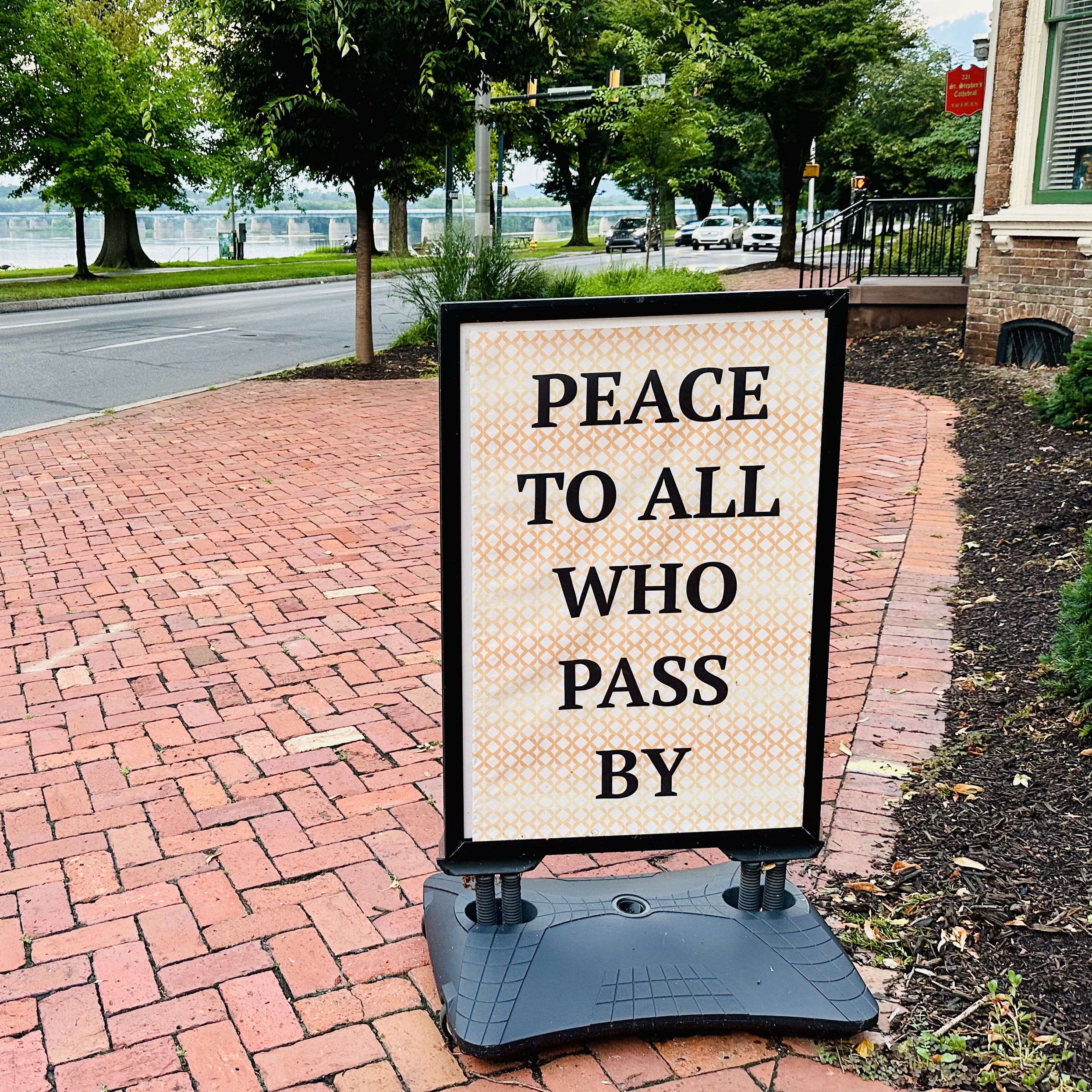
When my friend kindly took me to see his new church in downtown Harrisburg — the one where he now worships instead of preaches, spending his time in the choir loft each Sunday instead of in the pulpit — we walked past an unassuming sidewalk sign in front of its doors. I spun on my heels to look at it again. “That’s yours?” I asked, astonished. “That?” he said, pointing to the sign that read simply: Peace to All Who Pass By. “Yes,” he replied. I spoke to him in a near-whisper, embarrassed, I suppose, to be talking shop in the streets. “It’s a benediction…” He smiled at me. “I know,” he said, conspiratorially. There was a growing lump in my throat; I wanted to weep. An unapologetic benediction, outside in broad daylight.
Before I left the New England church I myself had served as Senior Minister, I brought back the Wayside Pulpit. Not too long ago, churches across denominations used this series of rotating signs to offer brief and inspired or inspiring messages to passers-by. Perhaps my favorite is this quotation from German philosopher Johann Wolfgang Goethe: “As soon as you trust yourself, you will know how to live.” The Wayside Pulpit was started early in 20th-century America and intended as non-sectarian gesture of goodwill to the wider public. It garnered some renown in the last century when a variant of it was credited with keeping a war veteran from jumping off the Brooklyn Bridge. The thought of one of its messages gave him hope, he reported, and kept him alive. Unfortunately, the Wayside Pulpit has all but disappeared from our religious landscape in recent years.
A very different sort of signage has taken its place, one I classify simply as Public Protestation. Possibly the most popular of these is that signature sign, Hate Has No Home Here. Try as I might, I cannot imagine who it is supposed to welcome to church or what it is meant to actually invite. I understand full well what it is meant to proclaim, a moral superiority as well as willingness to scold. But I cannot imagine these impulses giving anyone the will to go on living when life seems to be losing its meaning. I cannot imagine them ministering to a lost soul. Exactly where does hate belong? One town over? One state?
A ministerial colleague of mine who several years ago resolved to never again attend another General Assembly took the greatest issue with what we called Actions of Public Witness, which were announced annually. “You mean that things we do where we all go to faraway cities and organize protests and take to their streets to tell them everything they are doing wrong in their town?” he would joke. “That thing that makes us seem like such marvelous ambassadors for our faith?” Yes, precisely that thing.
When one of these were organized, we were instructed to bring with us our Side with Love denominationally-issued paraphernalia in brightest yellowish-orange, to stay on point, presumably, and be sure we kept our messaging literally and figuratively uniform. After I retired in June, I passed all such paraphernalia of mine on to a younger minister starting work at a nearby church. I had grown uncomfortable with the verbiage, because it sounded as though we had somehow made love itself a partisan issue, as though the people who agreed with us — on matters of public policy, say, or candidates for higher office — were plainly loving, while those who did not were obviously hateful.
Within our denomination, we were asked to virtue-signal without ceasing. Instead of engaging one another in substantive dialogue around important issues, we made anti-oppression “trainings” with some fairly dubious trainers mandatory. We created environments that were graceless and merciless. We devised elaborate and restrictive social contracts that we insisted on calling covenants, and then weaponized them against one another. Increasingly we endorsed identity politics and amplified ad hominem arguments. Embarrassingly often, we resorted to sloganeering. We positioned ourselves as being in such total alignment with love that we hated hate with a passionate intensity. Over the years, we regularly and energetically demonized people we perceived to be in the opposition. It became incumbent upon us as people of faith to tirelessly seek ways to identify and shame the haters.
Surely we can all see the spiritual dilemmas and inherent contradictions that these trends usher in, yes?
A key initiative that Braver Angels announced in 2023 as part of it Rise for America campaign was targeted outreach to faith communities with the intention of helping them to depolarize discourse in the public square. More and more in this country, we delegates recognized, people of faith were being unified around what they hated instead of what they loved. We were in danger of losing the very idea of spirited debate. Hosea Ballou, a founder of American Universalism, famously said: “If we agree in love, there is no disagreement that can do us any injury, but if we do not, no other agreement can do us any good. Let us endeavor to keep the unity of the spirit in the bonds of peace.” My fervent hope is that we Americans do not surrender this endeavor altogether, that we look to keep that unity of spirit in the bonds of peace, whatever our religion.
Before I decided to take early retirement, I wistfully told some ministerial colleagues that given the increased polarization in America today, I was no longer convinced that our denomination was on the side of the angels. One of them sent me an angry text this fall complaining that I had been “denouncing” the denomination as “a force for evil”, which is a curious interpretation of that original reservation I voiced — rather wistfully, I might add. It speaks to the fever pitch of our contemporary conversations and all the tones that our ears have grown deaf to these days. Who goes courting a crisis of faith? It’s hardly a casual matter.
What touched me most about that Peace to All Who Pass By sign that I stumbled over in Harrisburg was its amazing combination of generosity and humility. At a more recent clergy event, I found myself sitting in front of a local church whose building exterior had become a patchwork of Public Protestation. Its declarations were made in block letters that seemed to shout at strangers on the street. Why protest that much? I wondered. Regardless of the merits of their various propositions, I was dispirited by those signs. I have served churches were the fiercest battles, the most ruthless tug-of-war games have been fought over whose banner or flag or sign or poster gets put out where and when, where competitive grievance has become amateur sport.
All this made me worry that the church and its grounds were reduced to mere sites for Public Protestation, where we were loudly announcing the echo chamber we were intent upon inhabiting, as we went about aggressively recruiting the like-minded. Remember Communion? It was not predicated on consensus. More recently, I have noticed that those individuals who are the most vocal about their desire for diversity have a particular kind of diversity in their sights — and a marked intolerance for it in its invisible forms, most especially for ideological diversity. Churches were once places where people could try to transcend their political differences; now they insist on eliminating potential political differences within their walls. The congregations suffer for it, certainly, but so too does our country, and our world.
In too many quarters, people are orthodox in textbook ways. This holds true for those on the right and the left sides of the American political spectrum. They believe that their holding the correct opinions or believing the right things somehow assures the world complete salvation. They claim attitudinal virtue; what seems to matter most is that they are not wrong in what they espouse. They also feel the need to be continuously espousing. The clergy colleagues I admire most these day are those who resist the pressure to issue yet another public statement or so-called “pastoral letter” keeping pace with a 24/7 news cycle. They have grown weary of making statements for the sake of making statements. Besides, the people who seem to care most about these pronouncement are the same people who are themselves eternally busy pronouncing. Those people will tell you that silence always and only signals complicity. That indeed is one of their most routine and self-satisfied pronouncements.
In a sermon he titled “Catholic Spirit,” the founder of Methodism English theologian John Wesley asked: “Though we cannot think alike, may we not love alike?” Today, hardly any preacher in a progressive mainline congregation dares ask such a question. Clearly, we need to think alike to love alike! Hadn’t you noticed? When I surrendered my pulpit and was no longer preaching more Sundays than not, my colleagues asked if I missed delivering sermons. Yes, I told them, but not nearly as much as I miss giving the benediction each week. However much I might like to draft a sermon, I love to impart a blessing. Of all the things churches can do, honestly, this thing seems the most singular and indispensable. A minister throws her arms up and out and suddenly there is room enough for everyone there to be blessed, including that minister herself, because people were brave and trusting enough to gather together, to pass the peace, perhaps, or find some other gesture of goodwill to extend to relative strangers.
I have a close colleague and dear friend who has never once mentioned retirement to me, despite her many decades of ministry. She has several Buddhist practices and principles that sustain her in the work; I suspect they contribute significantly to her career longevity. Whenever she encounters someone who appears to be suffering or struggling, she repeats to herself: “Just like me, this person wants to be happy.” I’ve since borrowed that refrain for myself. Honest to God — what could be more obvious? Of course that person wants to be happy; of course I do, too. We all do. We may agree that there are better or worse ways to pursue it, but would we deny anyone the pursuit of happiness itself?
The prior motto of the PA state tourism board was You’ve Got a Friend in Pennsylvania, which was a nod to the Quaker influence on that state. If I take a full tally, I myself have more than a couple of friends in PA. Years ago, I did my chaplaincy training at a Quaker hospital outside Philadelphia at the same time that my husband was doing his medical residency at another hospital across the city. We lived in the same apartment building on South Street, and depending on how you tell the story, I was the girl next door or he was the boy next store. No matter: we were neighbors. We also met in an election year, when we were campaigning for different presidential candidates. Because of that, we were told our love would never last. Yet it has lasted quite a while now — in fact, it has taken us all the way to World’s End and back again.
Doubtless, I will be a minister until the day I die. Certain habits prove hard for me to shake, if not impossible. Each time I walk by a church, for instance, I read the signs — all the signs — for tone as well as content. Do they indicate that the world is fundamentally a cruel place or a kind one? Do they suggest that the neighbors should be invited to join us or must be persons we consider suspect? Do they imply that those who are not immediately for us are necessarily against us? Do they welcome outsiders as friends or greet them as foes? Do they indicate that we can trust ourselves and one another to “know how to live”, as the Wayside Pulpit once promised? Do they emphasize an ethos of shared humanity and extend an open embrace to the whole human family?
In his brilliant essay “The Power of the Powerless”, late Czech president Vaclav Havel points to an imaginary greengrocer’s sign as an instance of totalitarian creep and uses it to parse the differences between slogan and semantics and sign. Ultimately, he concludes, “Ideology is a specious way of relating to the world. It offers human beings the illusion of an identity, of dignity, and of morality while making it easier for them to part with those.” Too many of our vital institutions are subject to ideological capture these days. As Havel’s work would suggest, far too many signs have gone up in far too many windows for the messages that they communicate to remain uncomplicated or uncompromised.
While I have not retired from ministry itself, I have retired one form of ministry from my portfolio altogether. I am done with ruthless religious sectarianism. I no longer want to march in the ranks of the righteous, especially not when I see those ranks closing so ferociously. As personally committed as I remain to universalist and catholic projects, I also observe that they are getting much harder to find. What we desperately need to offer one another during these divided days are our sincerest well-wishes. We need to develop the spiritual discipline of at least mustering them. The churches I’m inclined to enter nowadays take care to offer people a blessing, an unqualified blessing, because they believe, as I do, that there is indeed a blessing undergirding and overarching all our human endeavors, that there is a universal blessing suffusing the whole of the human condition. A blessing here. A blessing there. Blessing anywhere and everywhere.
How I envy those Buddhists the loving-kindness meditations they do in public and private: May I be happy and at peace… May you be happy and at peace… May all people everywhere be happy and at peace… Whether or not you are bound to PA or another World’s End any time soon, friend, may your heartfelt pursuits bring you happiness and peace — and may you wish those same things to people walking toward you and also away from you, to everyone going and coming, and from whatever direction.


 The Reverend Dr.
Dearest Reverend Dr., Thank you wholeheartedly for taking this time to site the world in a loving space by sharing your thoughts with positive and sensitive words that matter! Always, Mary.
May you and your husband be happy and at peace.
Thank you for this: “The churches I’m inclined to enter will take care to offer people a blessing, an unqualified blessing, because they believe, as I do, that there is indeed a blessing undergirding and overarching all our human endeavors, that there is a universal blessing suffusing the whole of the human condition.”